
SUPERNATURAL FICTION · JAPAN AFTER DARK
A Dead Secret: Her Son Saw Her After the Funeral. She Would Not Speak.
They gave away her clothes. They emptied her drawers. Every night, the dead woman came back to look at what they had missed.
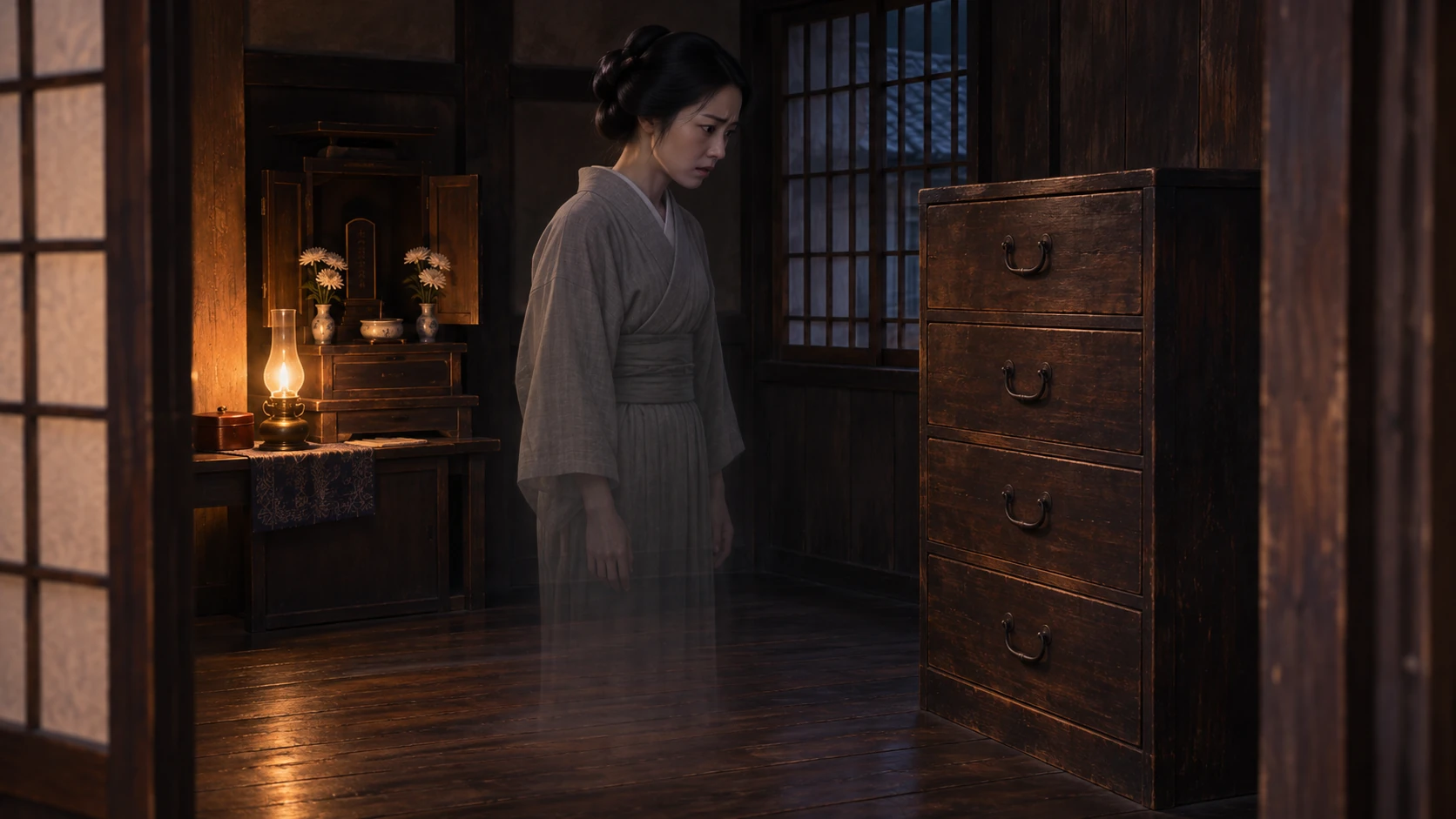
The boy said his mother was upstairs. The family had already buried her.
She had smiled at him. She would not speak. That was what frightened him enough to run away: the familiar face, the familiar smile, and no answer.
In “A Dead Secret,” published in Lafcadio Hearn’s Kwaidan in 1904, a household discovers that death has left something unfinished in an ordinary chest of drawers. This is literary ghost fiction, and its most disturbing possession is small enough to hide beneath a sheet of paper.
The part of her life they could describe
O-Sono is the daughter of Inamuraya Gensuke, a wealthy merchant in Tamba, also written Tanba. Her father considers her too gifted to be educated only by local teachers. He sends her to Kyoto with trusted attendants to learn the accomplishments expected of cultivated women.
Afterward she marries a merchant named Nagaraya, a friend of her father’s family. Hearn describes their marriage as happy. They have a son. During the fourth year of married life, she becomes ill and dies.
The account gives the family an intelligible life to mourn: daughter, student, wife, mother. It says nothing yet about what she kept to herself.
Then her son reports seeing her. When relatives enter her former upstairs room, a small lamp near the shrine illuminates her figure. Her head and shoulders are distinct. Below the waist she fades into transparency.
She stands in front of the tansu, the chest still holding her clothes and ornaments. She does not explain why.
They remove everything they think matters
Her mother-in-law offers an explanation. O-Sono must be attached to her belongings; giving them to the temple may allow her spirit to rest. It is the mother-in-law’s reasoning within the story, and the family accepts it.
The next morning they empty the drawers and send the clothes and ornaments away.
That night O-Sono returns. The next night she returns again. Her attention remains fixed on the same piece of furniture, although the things her family believed she wanted are gone.
The repetition changes the room. A chest that once held ordinary possessions becomes something nobody can successfully empty. The family has acted on its understanding of O-Sono, and her continuing presence quietly contradicts it.
At last the mother-in-law goes to the local Zen temple. Its elderly head priest, Daigen Oshō, suggests that something in or near the chest still troubles her. He agrees to spend the night in the room, with strict instructions that nobody enter unless he calls.
Beneath the bottom drawer’s lining
Alone, the priest reads sutras and waits. Late in the night O-Sono appears, looking anxiously toward the chest. He addresses her by her posthumous Buddhist name and offers help. A slight movement of her head seems to give permission.
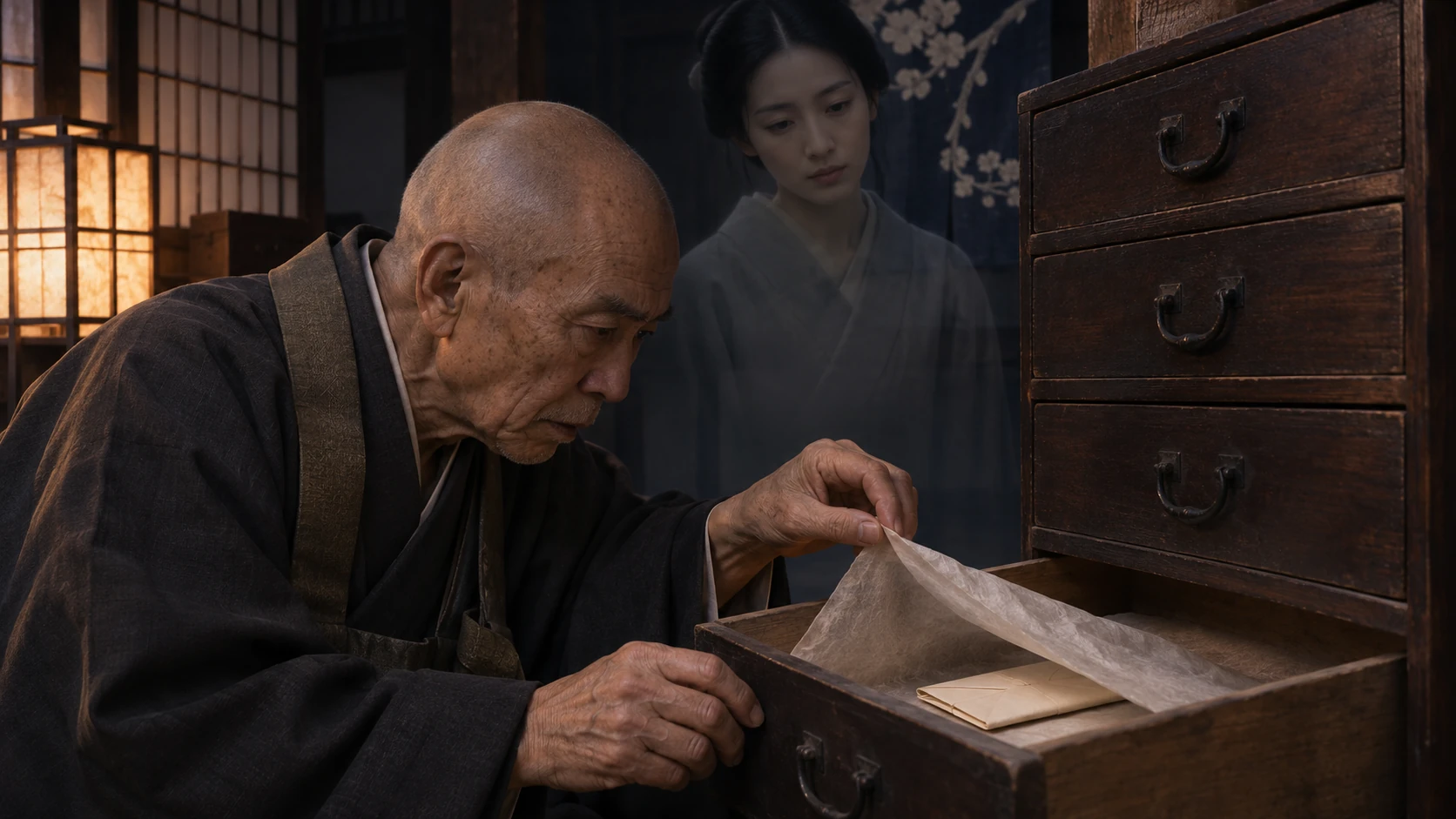
He opens the drawers one after another. He searches behind and underneath them. Nothing. The apparition continues watching.
Then he thinks of the paper lining.
Under the first lining there is nothing. Under the second and third, nothing. Beneath the lining of the lowest drawer, he finds a letter.
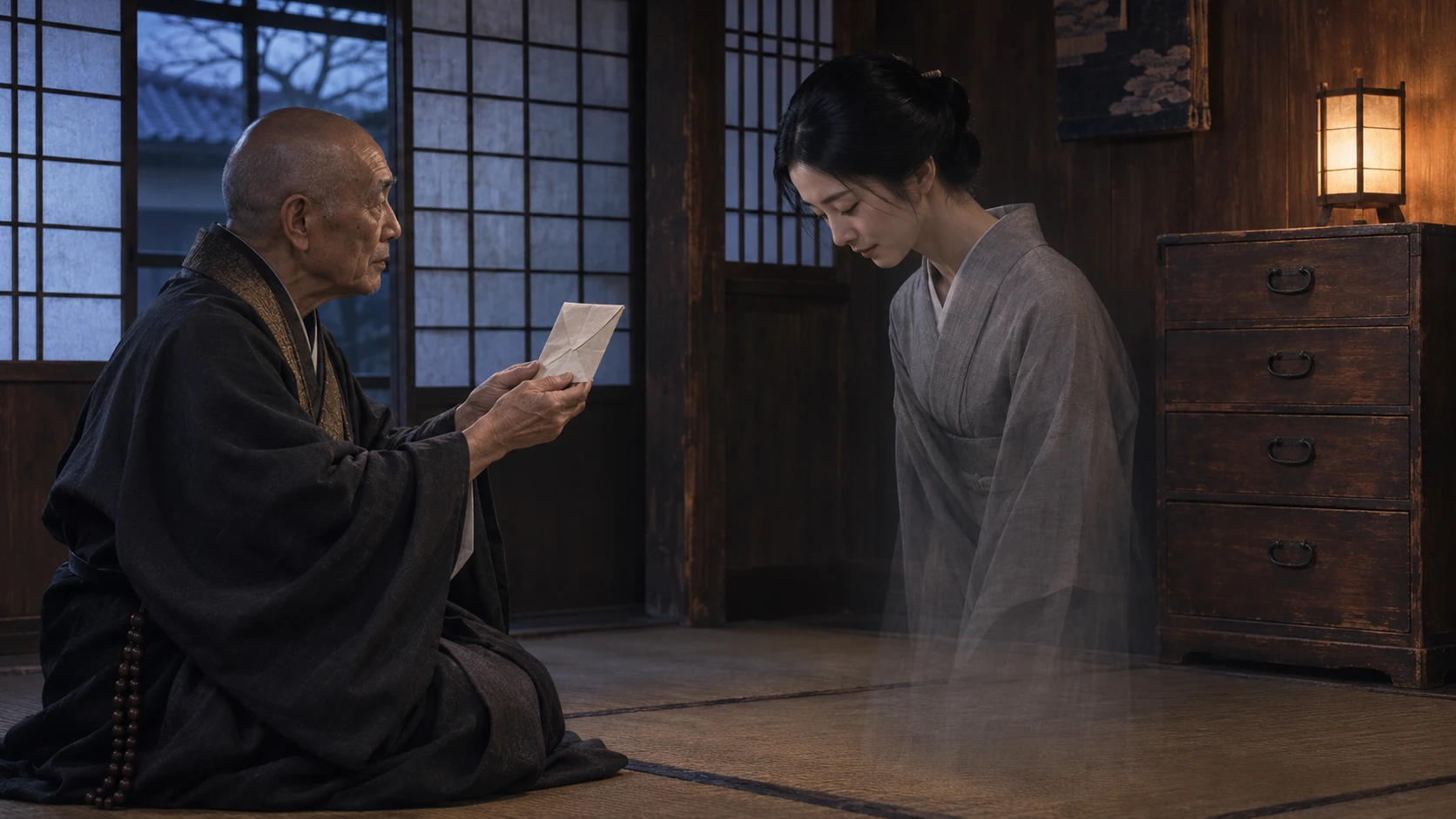
O-Sono turns her gaze toward it. When he asks whether she wants it burned, she bows.
There is no struggle with the ghost. The difficult act is recognizing that she has been asking for something all along.
One reader, then ashes
Daigen promises to burn the letter at the temple that morning. He also promises that nobody except himself will read it. O-Sono smiles and vanishes.
At dawn he tells the waiting family that she will not return. She never does. The letter is burned.
Hearn supplies one last fact: it was a love letter received during her studies in Kyoto. Its contents remain the priest’s knowledge alone, and die with him.
The story does not identify the writer. It does not tell us what the letter promised, what O-Sono feared, or whether anybody had been betrayed. Filling those gaps would turn a withheld life into an accusation.
One reading is that the haunting protects her privacy. Her family can distribute her belongings, but cannot be allowed to inherit every part of her. The priest ends the haunting by agreeing to keep something from them.
What an empty drawer can keep
The family receives peace without an explanation. The priest receives the explanation and accepts silence. O-Sono leaves only when she knows the paper will not survive her.
Perhaps that is the story’s sharpest discomfort: the person you love may have spent years protecting something you never knew existed.
If someone returned every night to watch an empty drawer, would you fear what was hiding there—or what you would learn about them if you found it?
Explore Japanify Ghost Tours for more stories that make familiar rooms, ordinary objects, and the people closest to us feel less certain after dark.
Explore more unsettling stories in the Japanify Journal, or step into the night with Japanify Ghost Tours.