
SUPERNATURAL FICTION · JAPAN AFTER DARK
Aoyagi: He Reached for His Dying Wife—and Found Only Her Clothes
Five years of marriage. One falling willow. Nothing left to hold.
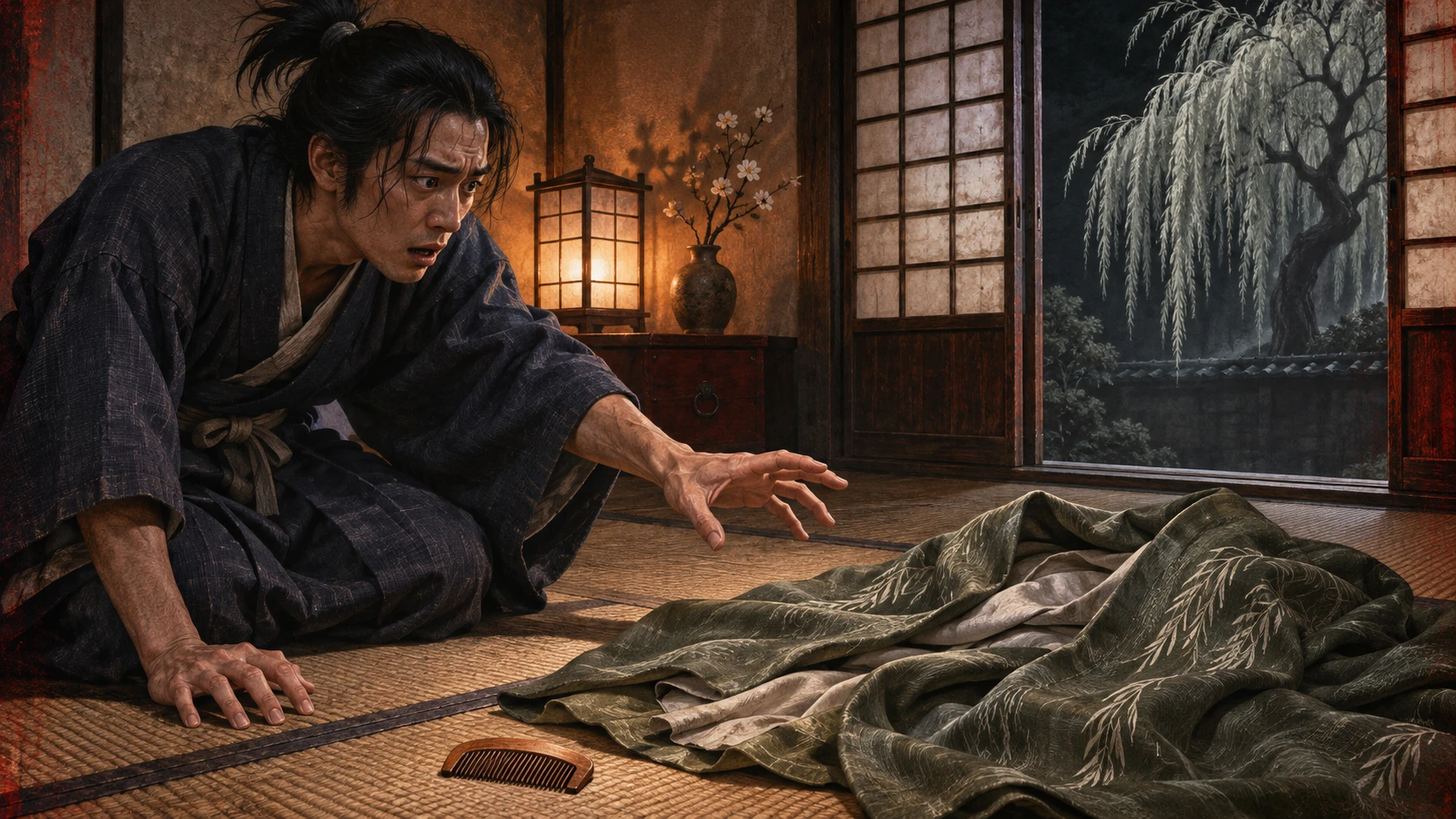
His wife screams. He reaches to catch her.
Her body sinks toward the floor—and his hands close on nothing. Her robes lie on the matting. Her hair ornaments remain. The woman he has lived beside for five years is gone.
Far away, someone has been cutting down a tree.
That is the terror at the heart of “The Story of Aoyagi,” a supernatural love story in Lafcadio Hearn’s Kwaidan (1904). In this literary tale, a samurai falls in love with a willow spirit without knowing what she is. He survives one threat to their marriage, only to discover that the real danger has been beyond his reach all along.
The house that should have been a rescue
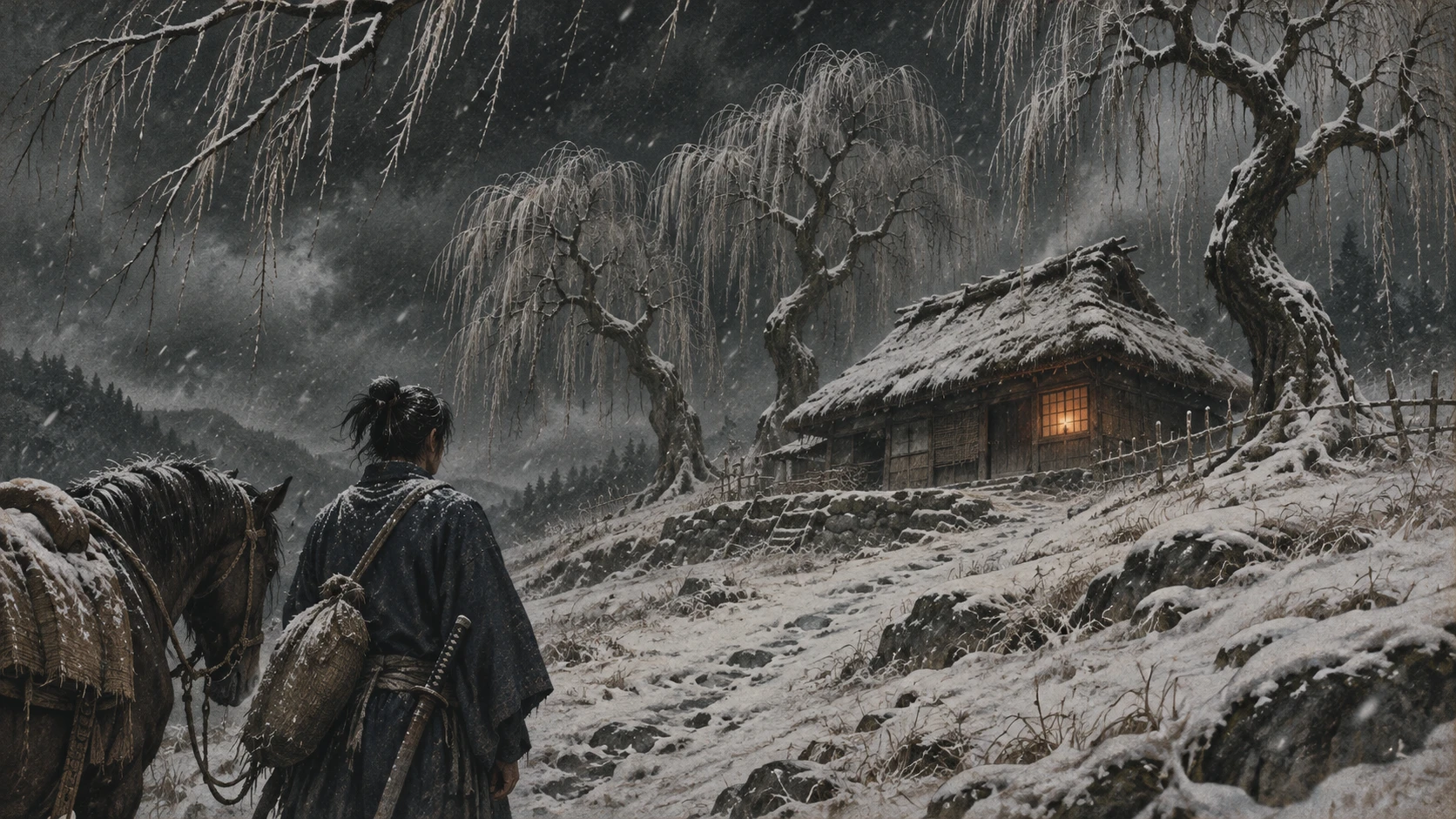
Tomotada is a young samurai serving the lord of Noto. Sent on a mission to Kyoto, he travels through Echizen during the coldest part of the year. Snow begins to fall heavily, his horse tires, and the next village is too far away.
Then he notices a cottage on a hill among willow trees.
An elderly couple take him inside. Their daughter, Aoyagi, is there too. Her clothes are poor, but her beauty and manner astonish him. When they exchange poems, she answers his admiration with affection of her own.
He has arrived looking for shelter. By morning, he cannot bear to leave Aoyagi behind.
Her parents agree to let her accompany him, but refuse the money he offers. They have little use for it where they live. At first, their refusal can seem like simple generosity. Only later does the family’s distance from ordinary human life become unsettling.
He wins her back—once
Tomotada takes Aoyagi with him. In Hearn’s telling, he has done so without obtaining his lord’s permission to marry, leaving their relationship vulnerable.
His fear is justified. A retainer sees Aoyagi and reports her beauty to Lord Hosokawa. She is taken into the lord’s residence, and Tomotada has no power to demand her return.
He risks sending her a poem.
When he is summoned, he expects punishment. Instead, Hosokawa has been moved by his words. The lord authorizes their marriage, and the couple are reunited in a wedding ceremony.
Five happy years pass.
Here, the tale gives them time. Aoyagi becomes his wife, their marriage a shared life rather than a single strange night in the mountains. The powerful man who took her away has returned her. The danger seems to be over.
Then, one morning, in the middle of a conversation about household matters, pain strikes her.
Someone is killing her. Nobody is in the room.
She turns pale and tells Tomotada that she is dying. He thinks she is ill and urges her to rest.
Rest cannot help her. The injury is happening somewhere else.
Aoyagi explains that her life belongs to a willow. Someone is cutting down that tree. There is nothing her husband can do from the room where they stand.
She asks him to recite the nenbutsu, a Buddhist invocation, for her.
Her form collapses toward the floor. Tomotada tries to support her, but finds nothing to hold. Her robes and hair ornaments remain on the matting. The woman inside them has disappeared.
Tomotada once knew where to send a plea, whose power he had to face, which door stood between him and his beloved. This time there is no door. No opponent stands before him. Somewhere, a tree is falling, and he cannot get his wife out of its way.
The family waiting on the hillside
Tomotada becomes a Buddhist priest and travels, praying for Aoyagi.
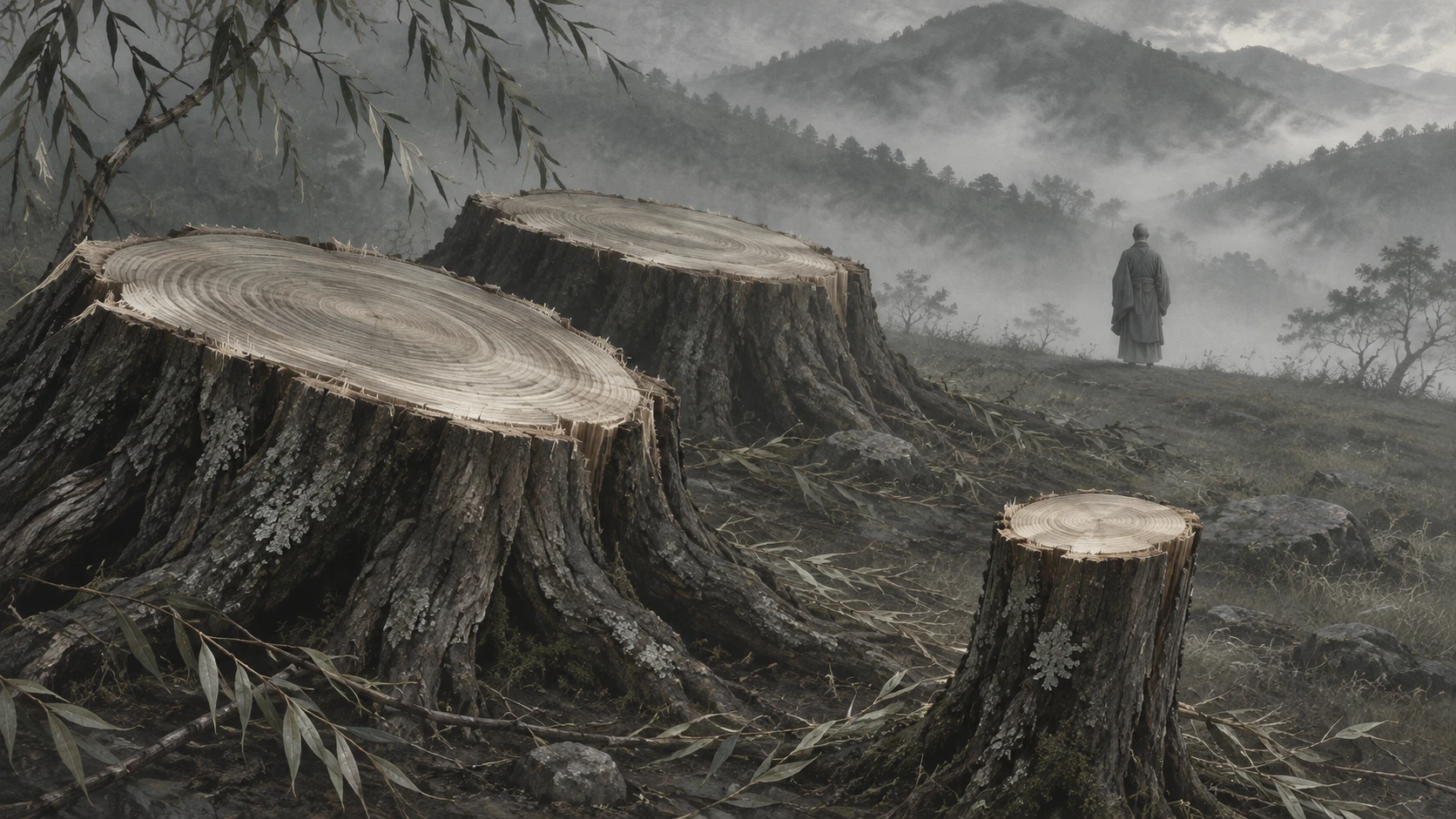
Eventually, he returns to the place in Echizen where they met. The cottage is gone. What remains is a group of three cut willow stumps: two old trees and one young one.
The final discovery changes the memory of that winter night. The elderly hosts and their daughter were not simply a family living beside the trees. The three trees held the family itself.
Tomotada establishes a memorial there and performs services for Aoyagi and her parents.
What the empty clothes leave behind
Aoyagi does not return to punish anyone. She is not a murdered human spirit demanding revenge. The dread comes from discovering how little Tomotada understood about the person closest to him.
Hearn also interrupts his own telling to explain that he supplied connective details where his Japanese source left gaps. That makes the story especially interesting to read as a crafted work: the apparent happy ending is allowed to settle before the supernatural truth destroys it.
The empty clothes make the loss unbearable to picture. Nothing has carried her out of the room. There is no body to bury. Everything that touched her is still there; everything Tomotada loved has vanished.
And somewhere, the person cutting the willow may never have known what they were doing.
If a tree could scream through the person you loved, would you recognize the sound before the final blow?
For more of Japan’s unsettling stories, explore the Japanify Journal. Or join our Kyoto Ghost Tour and discover how different an ordinary path can feel after dark.